A podcast with Ethan Lin 林以安
Ancient Chinese Wisdom
for Modern Life.
When to act. When to wait. How to find your footing when life changes.
Explore the I Ching and Chinese philosophy in plain English, through questions about work, relationships, and the choices in front of you.
Listen to the first episode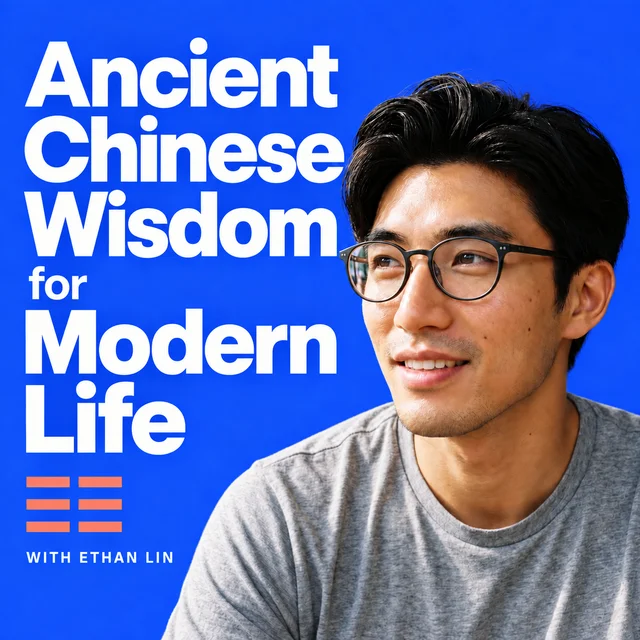
When to act,
when to wait.
You’re doing what used to work. It isn’t helping anymore. How do you tell persistence from stubbornness, or patience from avoidance?
A first look at timing, change, and what the I Ching can bring to everyday decisions.
Press play. Take a moment.
Full episode. No sign-in needed.
Read the transcript
You keep doing what used to work, but it isn't helping anymore.
So you try harder.
Maybe you stay more disciplined. Maybe you give it more time. Maybe you tell yourself not to give up.
But how do you know whether persistence is still the right response?
When does persistence become stubbornness?
And when does patience become avoidance?
Knowing what a particular moment calls for is one of the reasons I find ancient Chinese philosophy so interesting.
Welcome to Ancient Chinese Wisdom for Modern Life. I'm Ethan Lin.
In this series, I want to take some of the most important ideas from ancient Chinese texts and ask a simple question:
What can they help us notice about the lives we are living now?
We'll begin with the I Ching, the Book of Changes.
Later, we'll move into the Tao Te Ching, Zhuangzi, and other Chinese classics.
But this won't be a series about memorizing ancient quotations, and it won't be about pretending that people who lived thousands of years ago had ready-made answers for every modern problem.
I'm interested in something more practical.
How can an old idea change the way we see a situation today?
Let me give you a simple example.
Imagine you've just joined a new company.
It's your first week.
You notice problems immediately. You have ideas. You want to show that you can contribute.
But you barely understand how the team works. You don't know its history. You don't yet know why certain decisions were made.
In that situation, staying quiet for a while might be wise.
Listen and learn. Understand the people and the system before trying to change it.
Now imagine the same person two years later.
You understand the business. You've earned people's trust. You can see a serious problem coming, but you stay quiet because you've become comfortable keeping your head down.
You're still staying quiet, but your reasons may have changed. Perhaps now you're afraid to speak up.
That difference interests me.
Good advice is rarely good in every situation.
"Be patient" can save you from a terrible decision.
It can also become an excuse for never making one.
"Never give up" can help you survive the difficult early stages of something worthwhile.
It can also keep you trapped in a strategy that stopped working a long time ago.
The difficult part is knowing which advice belongs to which moment.
And this is where the I Ching becomes fascinating.
At its center are sixty-four hexagrams, each made from six broken or unbroken lines.
Historically, the I Ching has been used for divination, and I don't want to erase that part of its history.
But in this series, fortune-telling is not what interests me most.
What interests me is the way the book pays attention to situations.
A situation begins, develops, and gains strength. Eventually, it reaches a turning point.
Something that was appropriate earlier may become dangerous later.
And the question is not simply, "What kind of person should I be?"
The question is:
What kind of situation am I in?
And what does this situation ask of me?
That is a very different way of thinking.
The I Ching is deeply concerned with these changes in timing and position.
And over the first part of this series, we're going to go through all sixty-four hexagrams, one by one.
We'll read the hexagrams one at a time. I'll explain the passages and discuss important differences in interpretation. When I connect them to work or relationships, I'll make clear where the text ends and my own reading begins. You don't need to have studied Chinese philosophy to follow along.
And the I Ching is only our starting point.
When we eventually turn to the Tao Te Ching, we'll encounter a different question: when does our effort become unnecessary forcing?
And when we reach Zhuangzi, we'll encounter another: how much of what we call reality is shaped by the limited point of view from which we happen to be looking?
We'll let them disagree when they disagree.
For now, though, I want to leave you with one small exercise.
Think of one situation in your life that feels stuck.
It doesn't have to be the biggest problem you have.
Just something you keep returning to.
Maybe it's a project.
A relationship.
A decision you haven't made.
Something at work that keeps frustrating you.
Now finish this sentence:
"I keep trying to solve this by."
And be specific.
I keep trying to solve this by working harder.
By waiting.
By explaining myself again.
By avoiding the conversation.
By making another plan.
By trying to control every detail.
Whatever your answer is, don't judge it yet.
Just notice the strategy you keep returning to.
Then ask yourself one more question:
Is this strategy still appropriate for the situation I'm in now?
Not: did it work before?
Not: is this what someone like me normally does?
Is it right for this moment?
That question takes us directly into the first hexagram of the I Ching.
It is called Qian.
Its symbol is Heaven. In its line texts, we encounter the image of the dragon.
At first, the dragon remains hidden.
Later, it appears.
Then it rises.
Eventually, it flies through the heavens.
And finally, it goes too far.
We'll read it as a story about strength, ambition, timing, and the danger of failing to notice that your situation has changed.
Next time, we'll begin with Qian, the first hexagram, and a question about ambition: how do you know when you've pushed too far?
Prefer your usual app?
Take the next question with you.
Get public episodes and selected essays in your inbox. Join the publication on Substack and choose the free plan.
Following in a podcast app doesn’t sign you up for emails.
Meet your host
Hi, I’m Ethan.
I was born in Taiwan and raised in America. My grandfather introduced me to Chinese traditional culture. This podcast is where I share what I’m still learning from it.
I’m interested in the moment an old idea helps you see a familiar problem differently. We’ll look at the texts, question the interpretations, and find something you can try in your own life.
More about Ethan LinListen wherever you feel at home.
Where do I subscribe?
Join free on Substack for new episodes and selected essays by email. Following the public show on Spotify or Apple Podcasts adds it to your listening library, but does not sign you up for Substack emails.
Is the podcast free?
Yes. Episodes are currently free to hear on this site, Substack, Spotify, and Apple Podcasts. There is no paid podcast membership at this time.
Is the podcast part of a personal reading?
The podcast is free public material. A personal reading is a separate, individually prepared service ordered through your Spacetime Blueprint account.